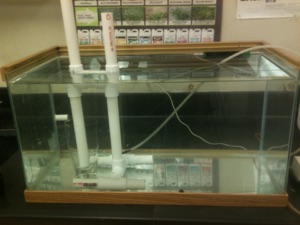
A Low Cost DIY Tilapia Egg Tumbler

A Low Cost DIY Tilapia Egg Tumbler
Would you like to know how to incubate and hatch tilapia eggs? The following blog provides updated formation including photographs for a 2002 paper I published in the North American Journal of Aquaculture (peer reviewed) that describes in full detail a simple tilapia egg tumbler (incubator) I designed and how to build it. Click here to download article: http://bit.ly/ZESh8I
UPDATED INFORMATION FOR 2017
With more and more people doing aquaponics and using tilapia as their primary fish species, there is increasing interest in how to breed them effectively. Now this blog is not going to detail the process of breeding tilapia. What it will discuss however is how to artificially incubate their eggs.
In summary of the 4 largest species of tilapia used for aquaculture around the world (Nile, Blue, Mozambique and Wami) all are what are known as maternal mouth brooders. This means the male will build a nest/ defend a territory and invite a female to mate with him. The female will come in and lay her eggs on the bottom and the male will then fertilize them. The female will then pick the eggs up in her mouth and leave. (Yes there are always minor variations on the theme but this is generally it.)
Now after the female picks up the fertilized eggs that things get interesting for the farmer. At this point the eggs can either be left with her to go through natures process leading to free swimming fry in about 2 or so weeks. From that point she goes back into her breeding cycle and can mate again shortly. For most people this is more than good enough. One large female tilapia can produce between 200 and 1,000 eggs, more than enough fish for a backyard farmer or the entire community for that matter. However, if you need more fish or would like better control over your fish production process, you can artificially incubate the eggs.
Artificial incubation is to take the eggs from the female (exactly how to do that and when will be described in a separate blog.) to them place them in a device colloquially called a “tumbler” to complete their development.
If you observe a female holding eggs in her mouth, you will note that she is keeping them in constant motion. This is both to aerate the eggs and to prevent infection by fungus or other pathogens. As described in the paper (http://bit.ly/ZESh8I), a tumbler is a device that emulates that process usually through the use of gentle water currents directed through eggs placed at the bottom of a container with a concave bottom.
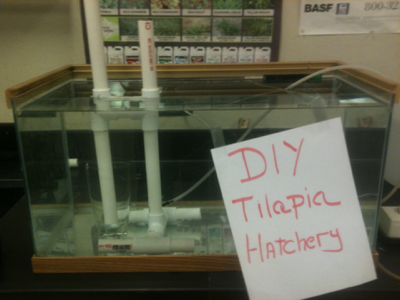
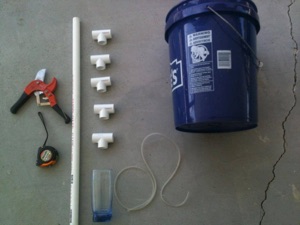
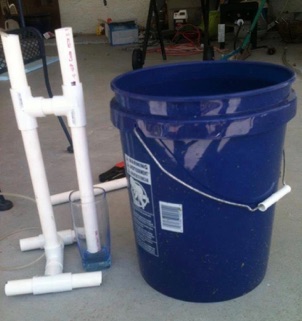
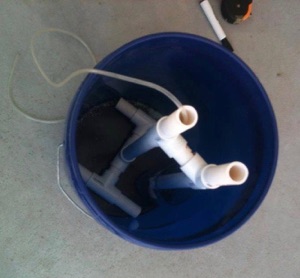
However to put things in perspective, the following photographs in combination with the instructions from the paper will make the construction almost self-explanatory. The neat thing about this particular design is that it is very inexpensive, parts can cost less than $10. It requires no glue and all parts are off the shelf. It is so simple that it can be fully assembled from scratch in less than 15 minutes. It requires only a small amount of air to function so no electricity need be run into the tank, only an airline from a small air pump with a two port gang valve to exhaust excess air. Though the paper recommends a 10 gallon aquarium be used to hold the functioning tumbler, as seen in the photographs, one can size it to use a hardware store 5 gallon bucket if need be.
One note. The airlift pump is very powerful. You need very little water to move the eggs. To be effective the eggs only need to be barely moving. However if you turn the air up too high, you can easily blast the eggs clear out of the hatching class. It will take some practice to get this right so caution is warranted.
So there you go. Since its posting on line a few years back this paper has been downloaded more than 2,250 times to individuals in 100 nations around the world. Have fun. Link to paper: http://bit.ly/ZESh8I
Link to paper: http://bit.ly/ZESh8I
Wednesday, May 17, 2017